News · Launch
Boston Dynamics electric Atlas — industrial path in 2026
Source: Boston Dynamics
Source: Boston Dynamics
Lead strip: Status: Production-intent / enterprise allocation (2026 fleets committed) · Availability: not a walk-up purchase · All-in cues: public list price — · Primary: /robots/atlas/ · Scoring: methodology
Evidence brief only — not a sold ranking. Production-intent ≠ public catalog buyability.
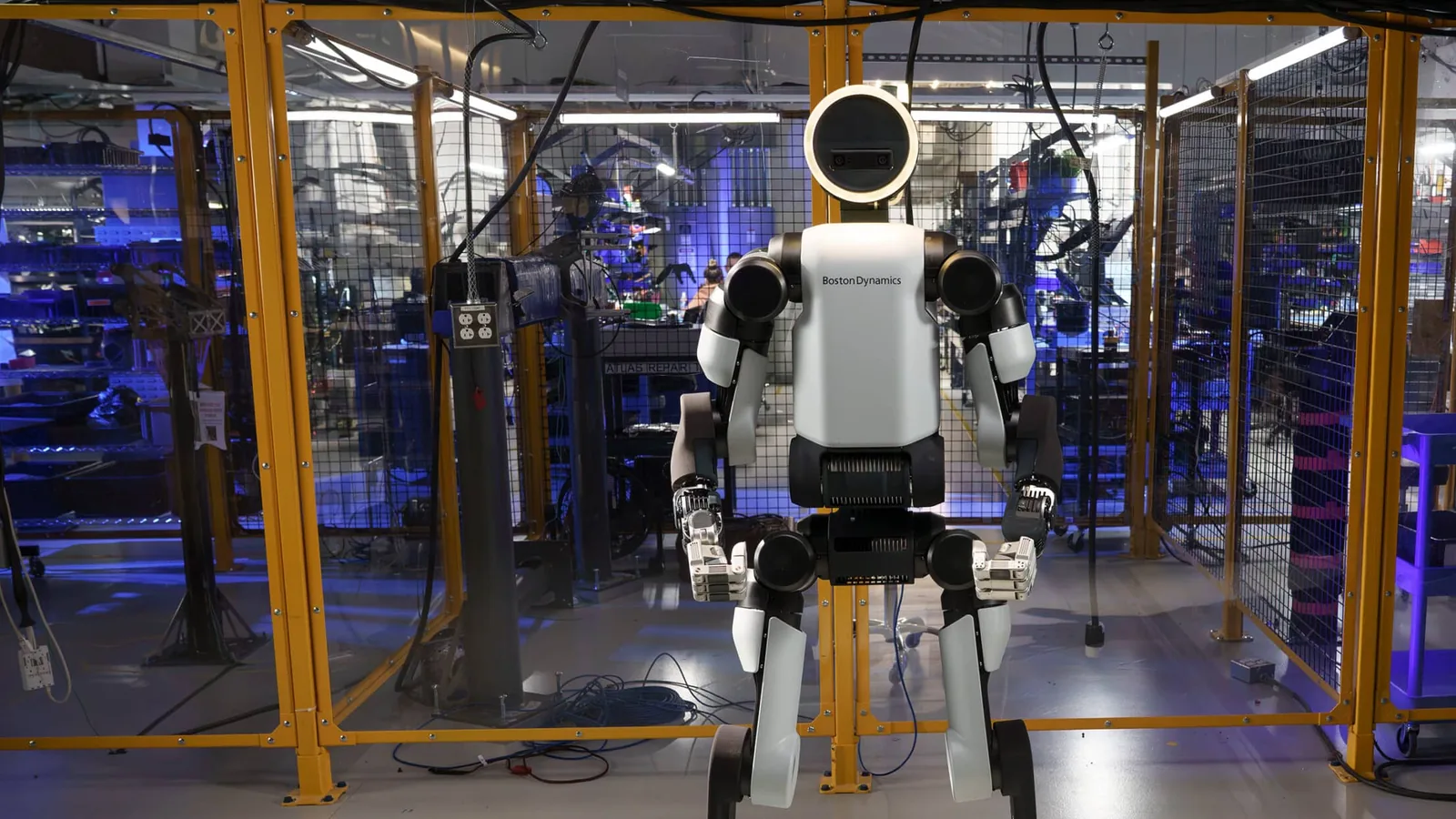
Boston Dynamics’ fully electric Atlas crossed from research spectacle into an enterprise product narrative at CES 2026: manufacturing start language, named first fleet destinations, industrial specs, and a DeepMind partnership for foundation-model cognition. For buyers, the useful split is what Boston Dynamics and Hyundai actually published, what remains allocation-only, and what stays — (list price, open order channel, multi-customer paid hours). Product home: Atlas.
Boston Dynamics’ 5 January 2026 release states that the company unveiled the product version of its new electric Atlas at CES, will begin production at its Boston headquarters immediately, and that all Atlas deployments are already fully committed for 2026, with fleets scheduled to ship to Hyundai’s Robotics Metaplant Application Center (RMAC) and Google DeepMind, plus plans to add additional customers in early 2027 (Boston Dynamics unveil).
The same post frames Atlas for industrial tasks from material handling to order fulfilment, with claimed specs including 56 DoF, reach to 2.3 m, lift up to 50 kg, water resistance, and operating temperatures from −20° to 40° C. Control modes listed: autonomous, teleoperated, or tablet. Orbit™ is cited for MES/WMS integration. Hyundai Mobis is named as actuator supplier.
Documented (vendor primary): production start intent; 2026 allocation to Hyundai RMAC + DeepMind; early-2027 customer expansion plan; published industrial spec envelope; DeepMind partnership for foundation models.
Not documented as a public buy receipt: unit count of the 2026 fleets (—), per-robot list price (—), walk-up checkout, or multi-year third-party tote/hour KPIs comparable to Digit’s logistics narrative.
Boston Dynamics’ enterprise product post says Hyundai is the first customer, with a completed deployment the prior year and a fleet scheduled to ship to RMAC in 2026, and that Hyundai plans a robotics factory capable of producing thousands of robots per year (Enterprise Robotics, Redefined). That post also claims ~4-hour battery life in typical use and autonomous battery swap in under three minutes, plus fenceless guarding / human detection cues.
Hyundai Motor Group’s CES 2026 AI Robotics materials describe Atlas for industrial applications (sequencing, assembly, machine tending), target annual production of 30,000 robot units by 2028, and a phased factory path: parts sequencing from 2028, component assembly by 2030 (Hyundai Motor Group CES strategy).
Read carefully:
| Claim | What it supports | What it does not prove |
|---|---|---|
| 2026 fleets to RMAC + DeepMind (BD) | Named allocation destinations | That Atlas is already at Digit-class multi-site tote hours |
| RMAC as training / validation hub | Supervised learning & process validation story | Immediate full-line factory autonomy at Metaplant |
| Sequencing 2028 / assembly 2030 (Hyundai) | OEM roadmap phases | 2026 public commercial availability |
| 30k robots/year by 2028 (Hyundai) | Capacity ambition | Audited 2026 output |
| Public list price / retail SKU | — | Walk-up purchase |
RMAC 2026 shipping ≠ Metaplant-wide 2028 sequencing at scale. Keep those years separate.
The unveil and enterprise posts announce a partnership to integrate Google DeepMind foundation models so Atlas can learn tasks faster and use site context. Trade coverage (e.g. The Robot Report) places DeepMind’s role around Gemini Robotics models and real-world manufacturing data collection — strategically important for autonomy claims, still not a consumer or SME order form (TRR: BD–DeepMind).
For scoring under our methodology, treat DeepMind as an AI stack / partner signal, not as third-party logistics throughput evidence.
Vendor-published envelopes (DoF, payload, reach, battery swap, IP67 in the enterprise post) are design claims. Spot/Stretch fleet experience (BD cites 2,000-plus Spot and Stretch deployments over five years in the enterprise post) is adjacent product history, not Atlas field hours. Do not score Atlas as Digit-equivalent warehouse tenure until named Atlas operational metrics appear at the same evidence depth.
Compare:
Different evidence classes — not a trophy board.
All-in CapEx/RaaS terms for Atlas: — until Boston Dynamics publishes them.
Not as a public catalog SKU in the materials cited here. 2026 production is described as fully committed to Hyundai RMAC and DeepMind, with additional customers planned for early 2027. Public list price: —.
Hyundai’s published path points to RMAC training/validation in the near term and parts sequencing from 2028, with assembly expansion toward 2030. Treat 2026 fleet shipping to RMAC as allocation/training — not as proof of full Metaplant-scale Atlas lines today.
Digit: longer published warehouse operational narrative. Figure 03: BMW partner sequencing project. Atlas: production-intent industrial product with allocated first fleets. Evidence classes differ; we do not sell a #1 ranking.
It is a named foundation-model partnership — a capability path. It does not automatically publish intervention rates, SLA, or fleet KPIs. Score AI partnerships separately from field receipts.
Atlas 2026 fleet unit counts, public price, and multi-site paid KPIs: —.